
Bethesda Hospital reborn
- Posted on 07/12/2023 17:18
- Film
- By abelozih@sante-education.tg
Extract from the article: L’hôpital Bethesda d’Agou-Nyogbo renforce ses offres de services en imagerie médicale. Le scanner de 32 barrettes est déjà mis en service depuis le 20 novembre 2023 à la grande satisfaction de la direction de l’hôpital et des populations. On peut réa
Bethesda
Hospital in Agou-Nyogbo is strengthening its medical imaging services. The
32-bar scanner has been in service since 20 November 2023, to the great
satisfaction of the hospital's management and the public. The scanner can be
installed at a social cost. When is a CT scan indicated for diagnosis?
According to Yendoukoa Laré, Senior Technician in Radiology and Medical Imaging
at Bethesda Hospital in Agou-Nyogbo, a CT scan can be used to detect a variety
of illnesses or anomalies, or even cancer, which can affect any part of the
body.
Victim of a road accident, Alexandre Seware, in his thirties, was admitted to Besthesda hospital in Agou Nyogbo. His injuries included a shock to the head, concussion and a fractured left foot. He was admitted to hospital for a CT scan. « It was the scan that saved him. Now that he's recovered, he can speak », says his older brother Nobodou, a trader in Agou Akoumawou, who accompanied him. « It's a great relief for us. We're pleased with the welcome and the care. My little brother is better today », said Nobodou.
Why
prescribe a CT scan?
A
CT scan is a medical imaging examination that allows very precise exploration
of multiple regions of the human body. The machine emits low-dose X-rays,
directed at the part of the body to be analysed.
The
indications for CT scans are very broad. « First and foremost, the
scanner is the examination of choice in the event of trauma involving various
organs such as the liver, spleen or kidneys.It can be used to detect bleeding,
lacerations, lesions or fractures. It is also the imaging test of choice for
acute pain, such as abdominal pain.In vascular terms, it allows precise
analysis of blood vessels. A CT scan
also provides a clear view of bone structures, which can be useful in assessing
the impact of certain chronic pathologies.Finally, it is one of the best
examinations both for the initial diagnosis and for the follow-up of certain
cancers », stresses Dr Etiam Koffi Sowu, Director of the Bethsesda
Hospital in Agou Nyogbo.
This
technique produces cross-sectional images, i.e. thin, contiguous slices. The
images are then processed by a computer and digitised.This produces a two- or
three-dimensional reconstruction. The examination is painless, fast and very
useful in diagnosing many pathologies.
What
does a scanner look like?
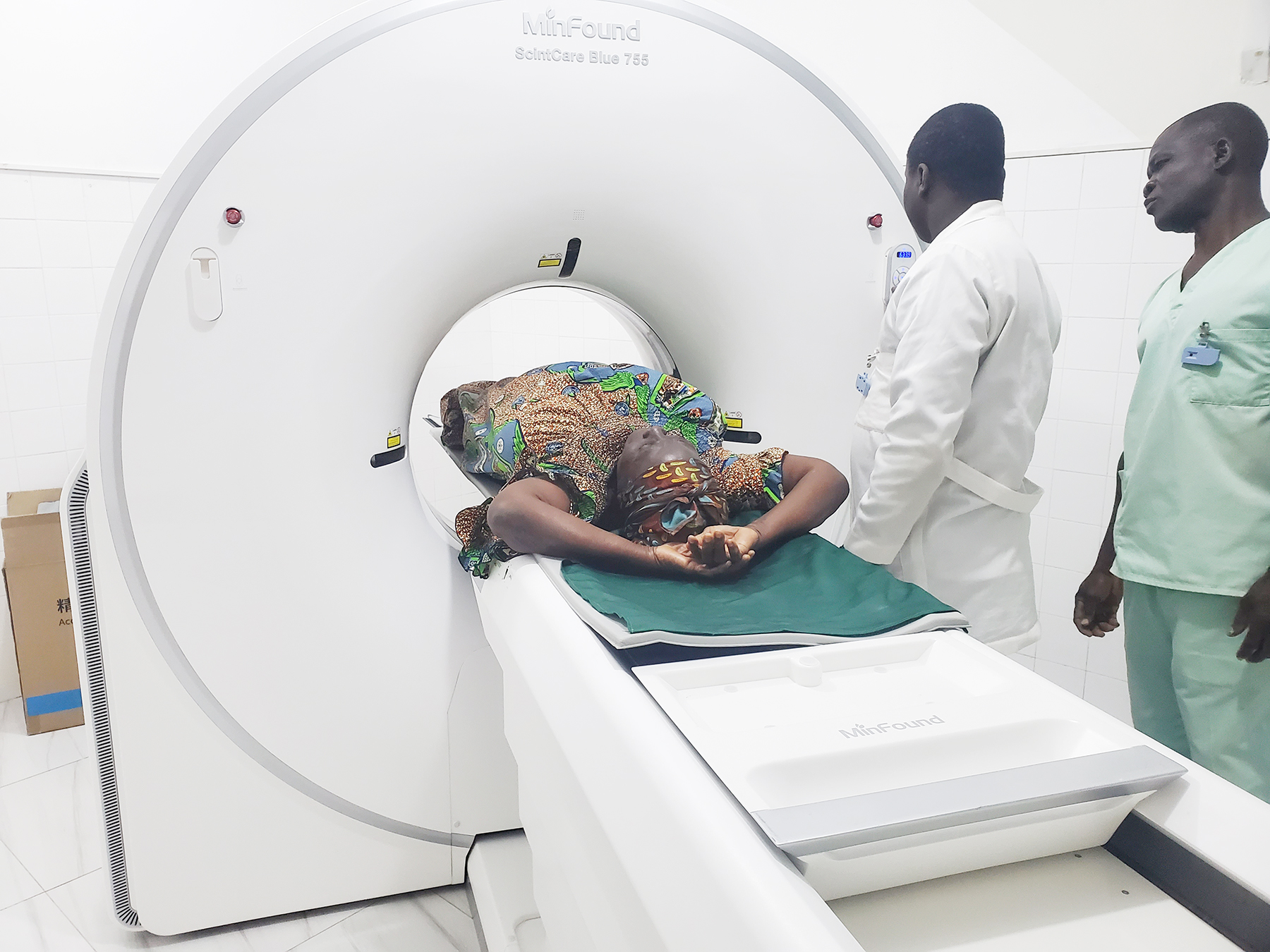
The scanner takes the form of a ring (about 2 metres in diameter) under which slides an examination table on which the patient lies. « Inside this ring is an X-ray tube that rotates around the patient throughout the examination. The radiology technician is separated from the main room by leaded glass. The technician looks into the room through a window and can communicate with the patient via loudspeakers.He follows the examination on computer screens that process the data and display the images », explains Yendoukoa Laré, Senior Technician in Radiology and Medical Imaging at Besthesda Hospital.The difference between a scanner and a magnetic resonance imaging (MRI) scan
Difference
between a scanner and a magnetic resonance imaging (MRI) scan
The
main difference between the two is the way in which they produce images. « A
CT scanner uses X-rays to capture images in three dimensions of the body.MRI
uses a magnetic field and radio waves to create three-dimensional images. In
addition, MRI is a precision examination that is more expensive. It can take 10
times longer to perform than a CT scan.However, both are important and
complementary », explains Yendoukoa Laré, Senior Technician in
Radiology and Medical Imaging.
How
do you prepare for a scan?
Most
of the time, says Yendoukoa Laré, « a scan does not require any
specific preparation.You can eat, drink and, above all, take your usual
medication. However, it is generally advisable to eat a light meal, as the
contrast agent prescribed by the doctor, which has to be injected into a vein, may
cause some nausea or vomiting ».
What
happens during the procedure?
On
arrival in the radiology department, the patient is taken in charge by a
radiology and medical imaging technician, who will take him or her to a
preparation booth to remove any metal objects.A final check for
contraindications is carried out by means of a few questions.
For
Yendoukoa Laré, it is therefore preferable for patients to bring their
prescription and a letter from the prescribing doctor. The technician will then
insert a venous line which will be used to inject the contrast product if
necessary. At the time of injection, the patient may feel a sensation of heat,
sometimes accompanied by nausea or vomiting. These reactions are not
systematic. However, you must remain perfectly still throughout the image
acquisition process.
« The
examination lasts approximately 05 minutes. It is carried out by the Radiology
and Medical Imaging Technician, and comprises several stages.The patient lies
on the machine's examination table.The table moves and the part of the body to
be examined is then placed inside the scanner, which is shaped like a large
ring, open at both ends and containing a radiation emitter-receiver.Inside the
ring, the transceiver rotates around the patient to take scouting images that
will be used to determine the precise area to be studied, in order to keep
radiation to a minimum. The patient can't see it, but they can hear the scanner
as it starts to turn around them », explains Yendoukoua
Laré.
Depending
on the pathology being investigated, one or more series of images may be
acquired. It is the radiology technician who, depending on the diagnosis made
by the doctor prescribing the examination, will decide which series of images
to take.
« In
the event of a problem, the patient, equipped with a microphone and an alarm
bell, is in constant contact with the medical team, who are seated behind a
glass pane that protects them from X-rays.
Once the examination is complete, the infusion is removed and a small
dressing applied, and the patient is taken back to the preparation room to get
dressed », explains technician Yendoukoua Laré.
The
doctor will then need time to analyse all the images acquired, look for
lesions, characterise them and, if necessary, carry out reconstructions.Once
the doctor prescribing the scan has been informed of the results, he or she
will be able to adapt the treatment, or even resort to other tests if
necessary, depending on the pathology detected.
William
O.