
Back pain: Interview with Innocent Tokpessa Lakna, Director of the National Orthopaedic Fitting Center (CNAO-Lomé)
- Posted on 08/11/2023 16:48
- Film
- By abelozih@sante-education.tg
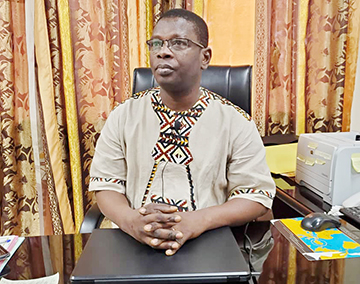
Extract from the article: Back pain can be caused by spinal deformities, worn bones or pinched nerves. Innocent Tokpessa Lakna, a physiotherapist by training and Director of the National Orthopaedic Fitting Center (CNAO-Lomé), explains the actions that aggravate and cause ba
« Poor posture is one of the main causes of back pain.... You need to take preventive measures and always consult a specialist if you experience back pain ».
Back pain
can be caused by spinal deformities, worn bones or pinched nerves. Innocent
Tokpessa Lakna, a physiotherapist by training and Director of the National Orthopaedic Fitting Center (CNAO-Lomé), explains the actions that
aggravate and cause back pain, and shows how to protect your back. According to
him, « your back needs to be as muscular as your abdominal muscles ».
Santé-Education
: Why does the back seem to be such a sensitive part of the anatomy?
Innocent
Tokpessa Lakna: Yes and no, it's sensitive. It's true that 80% of
people will one day have back pain. Just as 100% of people will one day have a
headache! So it's all relative.
The problem
isn't having back pain once in a while or once in a while. The real problem is
when the pain sets in and becomes chronic. You can't really predict, when the
pain first appears, whether it's going to come back regularly or not. It's
usually after the fact that we realise that there was indeed a risk.
As for
explaining the frequency of low back pain in humans, I would say first of all
that it is inherent to our condition as bipeds. In fact, in vertebrates that
move around on all fours, the pressure of gravity is not applied in the same
way to the intervertebral discs.In these vertebrates, disc herniations are
extremely rare. In humans, on the other hand, gravity applies a great deal of
continuous pressure on the discs and their junctions, so that they (the discs
and their junctions) wear out much more easily.
The trouble
is that we generally realise this late.Because the discs are poorly innervated,
they are destroyed little by little in silence, without pain or perceptible
signs.
Don't spinal
curvatures cause pain?
No, on the
contrary, the curvatures of the spine are physiological, necessary for our
staturodynamic balance.
The spinal column is made up of the cervical spine, which curves inwards (cervical lordosis), the dorsal spine, which curves outwards (kyphosis), and the lumbar spine, which curves inwards (lumbar lordosis). These curves play an important role in maintaining posture and locomotion through the spinal column.
How much
pain can bad posture cause?
Poor posture
is one of the main causes of back pain.There are no precise scientific data,
but it is estimated that more than half of chronic low back pain is caused by a
slightly forward posture: the torso is bent imperceptibly.Most of the time, we
notice that people with back pain are leaning forward very slightly. It's very
discreet, so the problem isn't easy to spot.This causes pain in the
paravertebral muscles along the spine, which are under prolonged strain.
Generally
speaking, good posture means respecting the curves.
What causes
this forward posture that causes pain?
More often
than not, it's the muscles in the front that are 'too short', so they pull a
little too much in relation to the muscles in the back. Paradoxically, contrary
to popular belief, having very strong abdominal muscles can actually lead to
this type of problem. In fact, the problem is not so much that the abdominal
muscles are powerful, but that the back muscles are much less powerful,
creating an imbalance.
Experiments have shown that the normal ratio of abdominal to back strength is 0.8. In people with low back pain, this ratio is 1.4. So the technique is not to lose your abs, but to strengthen your back muscles.Little by little, the position will straighten out and return to a vertical position.
Are there
any physical or sporting activities that are particularly recommended?
The recommended sport is one that you want to do and that will not cause any harmful effects. The therapist will show the patient exercises to strengthen muscles that are too weak and to relax contracted muscles. There is no ideal sport and no proscribed sport.It has often been said that swimming is the sport par excellence.In fact, the type of sport depends on the individual.If it's swimming above all, you have to want to do it. If you prefer jogging or even horse-riding, there are no contraindications. The most important thing is to have the right physical activity to work the muscles.
What role
does a physiotherapist play in the treatment of back pain?
Physiotherapists
work to strengthen muscles and improve proprioception.He works in three
stages.Firstly, he will relieve 80% of the mechanical stiffness and 20% of the
pain. This is done through muscle stretching and specific mobilisation with the
patient. Secondly, the physiotherapist will seek to maintain muscle balance,
particularly in the spinal muscles.
The physiotherapist will then provide the patient with the means to maintain themselves by offering advice, sometimes by adapting their workstation to improve ergonomics, etc.
Advice for
the general public
Take
preventive measures and always consult a specialist in the event of back pain.
Interview by
Abel OZIH