
Hearing revolution: Overcoming deafness with 3D printing
- Posted on 25/03/2025 12:22
- Film
- By abelozih@sante-education.tg
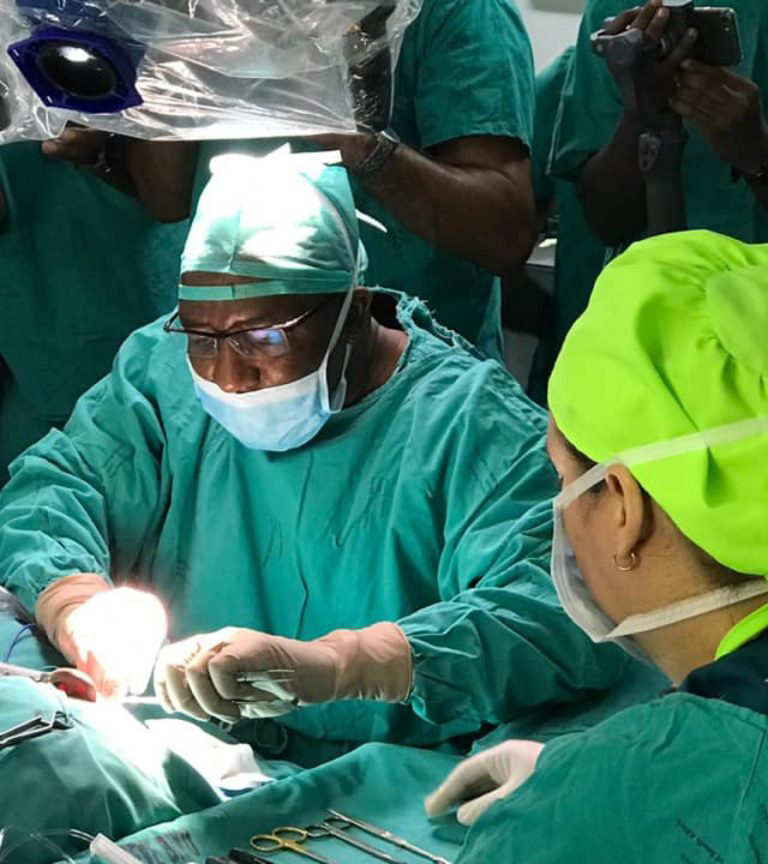
Extract from the article: Visionary South African surgeon Dr Mashudu Tshifularo has made history with the first ever 3D printed middle ear ossicle transplant. This feat, performed in 2019 at the Steve Biko University Hospital in Pretoria, has opened up a new era in the treatm
Visionary
South African surgeon Dr Mashudu Tshifularo has made history with the first
ever 3D printed middle ear ossicle transplant. This feat, performed in 2019 at
the Steve Biko University Hospital in Pretoria, has opened up a new era in the
treatment of hearing loss, offering an innovative solution that is accessible
to all.
Dr
Tshifularo has made history by performing the first successful transplant of
3D-printed middle ear ossicles. The operation, performed on a patient suffering
from post-traumatic hearing loss, involved analysing the middle ear using a 3D
scanner, designing customised implants and inserting them.The minimally
invasive technique speeds up recovery and improves hearing.
It
offers an affordable alternative to traditional titanium implants, and opens up
access to better hearing for everyone, from newborns to adults.
The
procedure, which takes around two hours, has a number of advantages: it is
minimally invasive, leaving minimal scarring thanks to endoscopic techniques,
and can be adapted to a variety of patient types. This advance is particularly
effective in treating lesions of the ossicles, the tiny bones that help
transmit sound. This innovation is part of a growing body of research into 3D
printing in medicine.
Advances
in this field are making advanced hearing care more accessible, particularly in
developing countries, by reducing the cost of producing implants, making it
possible to create tailor-made implants, improving the precision and
effectiveness of surgical interventions, and paving the way for other
applications of 3D printing in personalised medicine.
Although
this procedure is particularly effective against certain pathologies, it
represents a major advance in medical technology.It is a reminder that medical
innovation is ubiquitous, and does not necessarily have to take place in the
four corners of the world, or in the world's most prestigious hospitals, in
order to offer new perspectives and improve the health and quality of life of
all.
Source: Curesure Medico